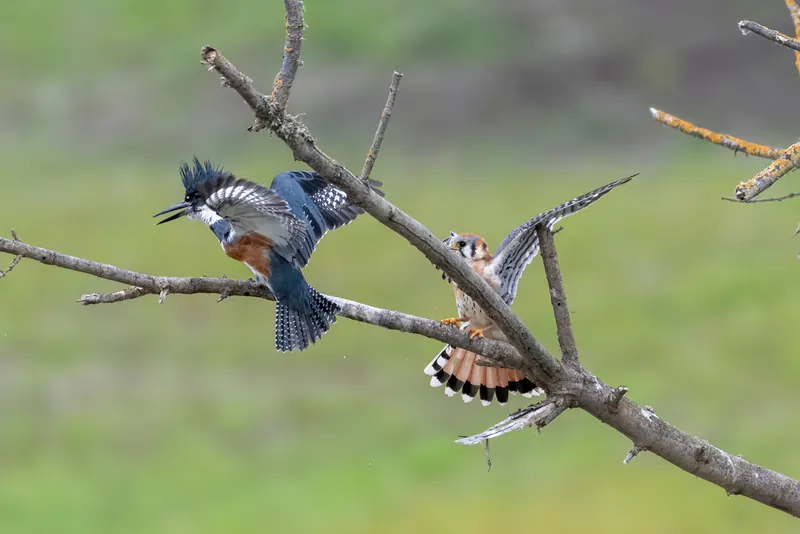
Belted Kingfishers are in Kentucky all year, but most are here in fall: numbers build from the second week of August, peak in late November (16% of checklists), and fall back by early January. In the quietest week (early June) they are still on about 4.4% of checklists.
When to look
Numbers buildAug 8-14the second week of August
PeakNov 22-30late November
Fall back byJan 1-7early January
FewestJun 1-7early June
Best: late November. Here all year; numbers build from the second week of August and fall back by early January. Peak: on about 16% of Kentucky checklists.
Jancommon
Febcommon
Marcommon
Aprcommon
Mayuncommon
Jununcommon
Julcommon
Augpeak season
Seppeak season
Octpeak season
Novpeak season
Decpeak season
Darker months: more checklists report it. Outlined: peak month.
Share of complete checklists reporting it, by week (4 per month). Grey bars: fewer than 10 checklists, not counted.
Frequency is the share of complete checklists in Kentucky that listed the bird, 2016–2025. It is not a head count, and it follows where and when people go birding. How to read it.
JanFebMarAprMayJunJulAugSepOctNovDec
today
0%few checklistsno data
Each county is shaded by the share of complete checklists there that listed the bird, blended with the weeks either side. Darker is more often. It follows where people watch birds, not how many birds there are. How to read it.
Willow LakeJefferson County, best late January · 32 checklists that week, 1,890 in all79%
Lake LibertyCasey County, best late September · 38 checklists that week, 243 in all73%
Shelby Lake (Snow Hill)Shelby County, best mid November · 22 checklists that week, 122 in all71%
Busy spots report more of everything; compare the checklist counts before you drive anywhere.
Best time of day
In Kentucky, the Belted Kingfisher is most often listed on checklists started between 8 and 10 am (11% of those checklists).
Share of checklists started in each local hour that reported it. It reflects when people go birding as well as when birds are active. Grey hours have too few checklists (under 2% of the state’s, or under 200) to judge.Week-by-week table
Month
Days 1-7
8-14
15-21
22-end
January
11%
9.3%
7.7%
9.0%
February
10%
7.6%
6.0%
7.8%
March
7.9%
7.4%
7.7%
8.6%
April
8.0%
8.0%
7.8%
6.5%
May
5.1%
5.2%
4.6%
4.7%
June
4.2%
4.2%
5.3%
5.5%
July
6.1%
6.8%
6.9%
8.7%
August
9.4%
11%
12%
13%
September
14%
14%
13%
14%
October
13%
13%
15%
15%
November
16%
15%
16%
16%
December
16%
13%
13%
12%
Neighboring states
Tennessee: arrives early August, 1 week earlier than Kentucky
Indiana: arrives mid July, 3 weeks earlier than Kentucky
Ohio: arrives the second week of July, 4 weeks earlier than Kentucky
Illinois: arrives early August, 1 week earlier than Kentucky
Common questions
When do Belted Kingfishers arrive in Kentucky?
Belted Kingfishers are in Kentucky all year, but most are here in fall: numbers build from the second week of August, peak in late November (16% of checklists), and fall back by early January. In the quietest week (early June) they are still on about 4.4% of checklists.
When do Belted Kingfishers leave Kentucky?
Belted Kingfishers never fully leave Kentucky: numbers fall back below half their usual rate by early January, but some are still reported in every week, about 4.4% of checklists at the low.
When is the best time to see a Belted Kingfisher in Kentucky?
The Belted Kingfisher is reported most often in late November, on about 16% of Kentucky checklists.
Where in Kentucky are Belted Kingfishers seen most often?
By county, Rockcastle County, Rowan County, and Gallatin County have the highest peak reporting rates for the Belted Kingfisher (counties with at least 200 checklists).