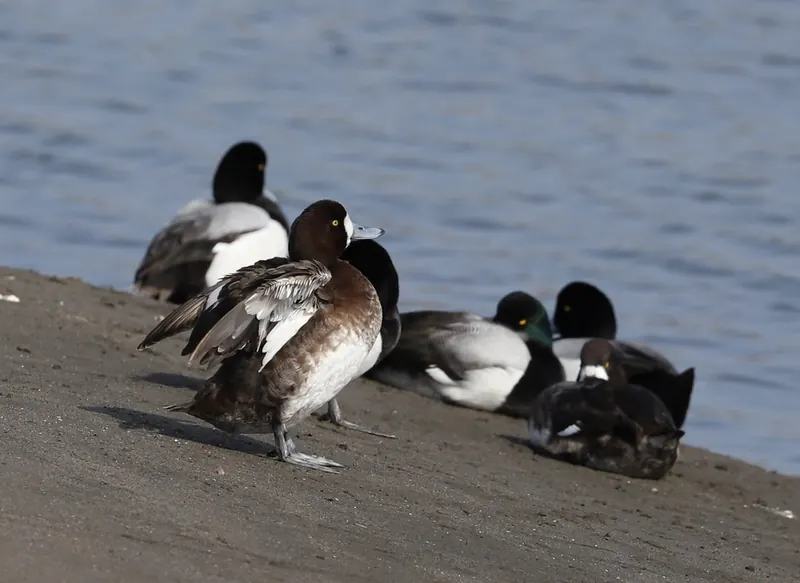
Greater Scaups are winter birds in California: the first arrive in late October, they are common by early November, peak in mid January (3.5% of checklists), and most are gone by mid April.
When to look
First arrivalsOct 22-31late October
Common byNov 1-7early November
PeakJan 15-21mid January
Most gone byApr 15-21mid April
Best: mid January. First arrivals late October; most are gone by mid April. Peak: on about 3.5% of California checklists.
Janpeak season
Febpeak season
Marpeak season
Aprcommon
Mayuncommon
Junrare
Julrare
Augrare
Seprare
Octuncommon
Novcommon
Decpeak season
Darker months: more checklists report it. Outlined: peak month.
Share of complete checklists reporting it, by week (4 per month). Grey bars: fewer than 10 checklists, not counted.
Frequency is the share of complete checklists in California that listed the bird, 2016–2025. It is not a head count, and it follows where and when people go birding. How to read it.
JanFebMarAprMayJunJulAugSepOctNovDec
today
0%few checklistsno data
Each county is shaded by the share of complete checklists there that listed the bird, blended with the weeks either side. Darker is more often. It follows where people watch birds, not how many birds there are. How to read it.
Lakeside ParkAlameda County, best mid February · 23 checklists that week, 453 in all86%
Faro PointAlameda County, best early February · 21 checklists that week, 1,007 in all82%
New MarshAlameda County, best the second week of February · 31 checklists that week, 1,483 in all82%
Mariner ParkSan Mateo County, best the second week of February · 21 checklists that week, 250 in all80%
Busy spots report more of everything; compare the checklist counts before you drive anywhere.
Best time of day
In California, the Greater Scaup is most often listed on checklists started between 12 and 2 pm (2.0% of those checklists).
Share of checklists started in each local hour that reported it. It reflects when people go birding as well as when birds are active. Grey hours have too few checklists (under 2% of the state’s, or under 200) to judge.Week-by-week table
Month
Days 1-7
8-14
15-21
22-end
January
3.3%
3.5%
3.6%
3.4%
February
3.2%
3.1%
2.5%
2.8%
March
2.9%
2.8%
2.5%
2.3%
April
2.0%
1.7%
1.6%
1.1%
May
0.7%
0.6%
0.4%
0.3%
June
0.2%
0.2%
0.2%
0.2%
July
0.3%
0.2%
0.3%
0.3%
August
0.2%
0.3%
0.3%
0.2%
September
0.2%
0.2%
0.2%
0.3%
October
0.4%
0.6%
0.9%
1.2%
November
1.5%
1.8%
1.9%
2.2%
December
2.5%
2.6%
2.5%
2.7%
Neighboring states
Nevada: arrives early November, 1 week later than California
Oregon: arrives the second week of October, 2 weeks earlier than California
Washington: arrives late September, 4 weeks earlier than California
Colorado: arrives the second week of November, 2 weeks later than California
Common questions
When do Greater Scaups arrive in California?
Greater Scaups are winter birds in California: the first arrive in late October, they are common by early November, peak in mid January (3.5% of checklists), and most are gone by mid April.
When do Greater Scaups leave California?
Most Greater Scaups have left California by mid April, when reports fall below half their usual rate. Stragglers are still reported until late April.
When is the best time to see a Greater Scaup in California?
The Greater Scaup is reported most often in mid January, on about 3.5% of California checklists.
Where in California are Greater Scaups seen most often?
By county, Alameda County, Humboldt County, and San Mateo County have the highest peak reporting rates for the Greater Scaup (counties with at least 200 checklists).