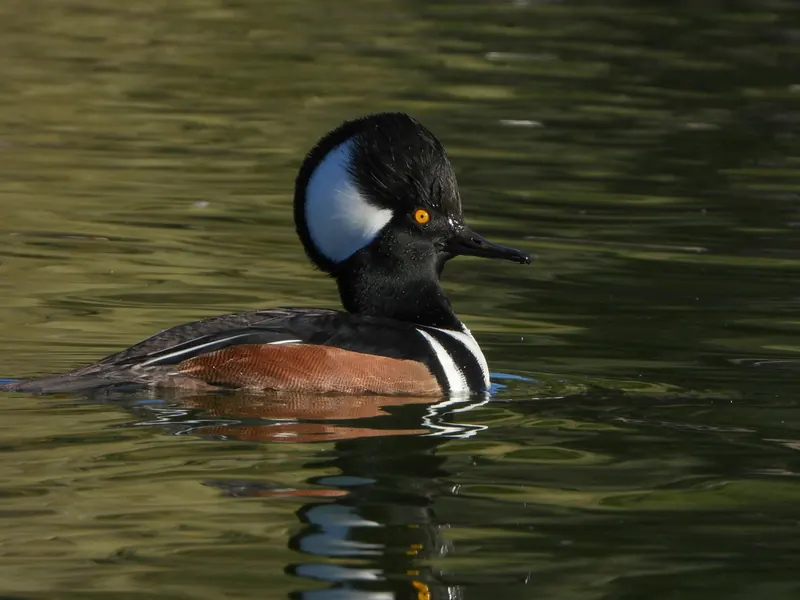
Hooded Mergansers are winter birds in West Virginia: the first arrive in late October, they are common by the second week of November, peak in early December (13% of checklists), and most are gone by mid March.
When to look
First arrivalsOct 22-31late October
Common byNov 8-14the second week of November
PeakDec 1-7early December
Most gone byMar 15-21mid March
Best: early December. First arrivals late October; most are gone by mid March. Peak: on about 13% of West Virginia checklists.
Janpeak season
Febcommon
Marcommon
Apruncommon
Maynot usually seen
Junnot usually seen
Julnot usually seen
Augnot usually seen
Sepnot usually seen
Octrare
Novpeak season
Decpeak season
Darker months: more checklists report it. Outlined: peak month.
Share of complete checklists reporting it, by week (4 per month). Grey bars: fewer than 10 checklists, not counted.
Frequency is the share of complete checklists in West Virginia that listed the bird, 2016–2025. It is not a head count, and it follows where and when people go birding. How to read it.
JanFebMarAprMayJunJulAugSepOctNovDec
today
0%few checklistsno data
Each county is shaded by the share of complete checklists there that listed the bird, blended with the weeks either side. Darker is more often. It follows where people watch birds, not how many birds there are. How to read it.
Pleasants CountyBest the second week of December · 63 checklists that week, 1,671 in all46%
Monroe CountyBest early December · 15 checklists that week, 1,298 in all30%
Summers CountyBest the second week of December · 86 checklists that week, 5,370 in all29%
Putnam CountyBest the second week of December · 10 checklists that week, 2,400 in all29%
Taylor CountyBest the second week of December · 39 checklists that week, 2,541 in all28%
Pendleton CountyBest early December · 23 checklists that week, 4,553 in all27%
Best spots
Share of checklists at the peak
Hulls LakePreston County, best late November · 41 checklists that week, 446 in all93%
Cheat Lake ParkMonongalia County, best late November · 26 checklists that week, 435 in all71%
Deckers CreekMonongalia County, best mid January · 22 checklists that week, 277 in all70%
Cow CreekPleasants County, best the second week of December · 20 checklists that week, 357 in all65%
Busy spots report more of everything; compare the checklist counts before you drive anywhere.
Best time of day
In West Virginia, the Hooded Merganser is most often listed on checklists started between 2 and 4 pm (5.2% of those checklists).
Share of checklists started in each local hour that reported it. It reflects when people go birding as well as when birds are active. Grey hours have too few checklists (under 2% of the state’s, or under 200) to judge.Week-by-week table
Month
Days 1-7
8-14
15-21
22-end
January
9.4%
9.8%
11%
11%
February
7.9%
8.0%
6.4%
8.1%
March
7.6%
6.5%
5.4%
4.2%
April
3.1%
2.0%
1.0%
0.4%
May
0.3%
0.2%
0.4%
0.2%
June
0.3%
0.3%
0.1%
0.1%
July
0.1%
0.1%
0.1%
0.1%
August
0.1%
0%
0.1%
0.1%
September
0%
0%
0.1%
0.1%
October
0.1%
0.1%
0.2%
1.2%
November
3.6%
9.2%
9.9%
11%
December
14%
13%
9.3%
9.2%
Neighboring states
Virginia: arrives late October, in the same week than West Virginia
Maryland: arrives late October, in the same week than West Virginia
Ohio: arrives mid October, 1 week earlier than West Virginia
Common questions
When do Hooded Mergansers arrive in West Virginia?
Hooded Mergansers are winter birds in West Virginia: the first arrive in late October, they are common by the second week of November, peak in early December (13% of checklists), and most are gone by mid March.
When do Hooded Mergansers leave West Virginia?
Most Hooded Mergansers have left West Virginia by mid March, when reports fall below half their usual rate. Stragglers are still reported until the second week of April.
When is the best time to see a Hooded Merganser in West Virginia?
The Hooded Merganser is reported most often in early December, on about 13% of West Virginia checklists.
Where in West Virginia are Hooded Mergansers seen most often?
By county, Pleasants County, Monroe County, and Summers County have the highest peak reporting rates for the Hooded Merganser (counties with at least 200 checklists).