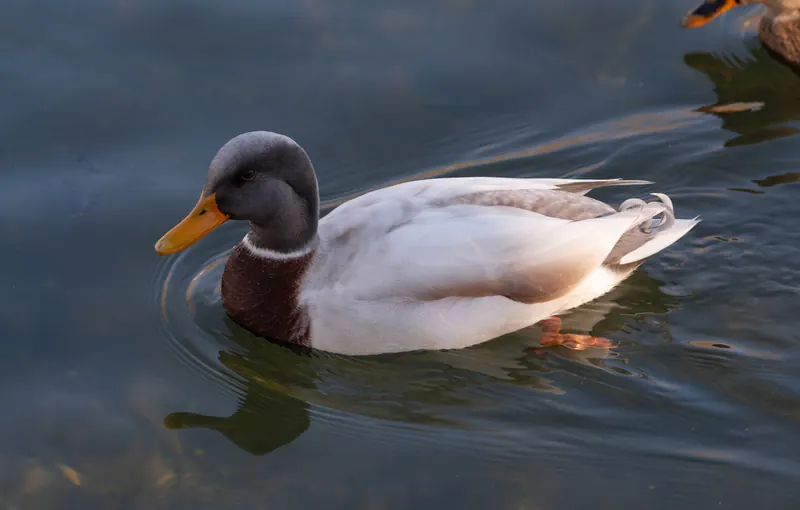
The Mallard is in Washington all year. It turns up on about 41% of checklists at its peak (mid March) and on 19% in its quietest week (early July).
When to look
PresentAll year
Peak weekMar 15-21mid March
Quietest weekJul 1-7early July
Best: mid March. Here all year. Peak: on about 41% of Washington checklists.
Janpeak season
Febpeak season
Marpeak season
Aprpeak season
Maypeak season
Juncommon
Julcommon
Augcommon
Sepcommon
Octpeak season
Novpeak season
Decpeak season
Darker months: more checklists report it. Outlined: peak month.
Share of complete checklists reporting it, by week (4 per month). Grey bars: fewer than 10 checklists, not counted.
Frequency is the share of complete checklists in Washington that listed the bird, 2016–2025. It is not a head count, and it follows where and when people go birding. How to read it.
JanFebMarAprMayJunJulAugSepOctNovDec
today
0%few checklistsno data
Each county is shaded by the share of complete checklists there that listed the bird, blended with the weeks either side. Darker is more often. It follows where people watch birds, not how many birds there are. How to read it.
Garfield CountyBest the second week of December · 17 checklists that week, 1,130 in all61%
Asotin CountyBest late October · 98 checklists that week, 4,316 in all60%
Benton CountyBest late October · 459 checklists that week, 23,565 in all57%
Walla Walla CountyBest mid April · 849 checklists that week, 35,829 in all56%
Lincoln CountyBest early April · 162 checklists that week, 6,135 in all56%
Thurston CountyBest early November · 1082 checklists that week, 68,352 in all55%
Best spots
Share of checklists at the peak
Historical ParkThurston County, best early January · 21 checklists that week, 434 in all100%
Roxbury HeightsKing County, best late March · 22 checklists that week, 405 in all100%
Flett Creek Holding BasinPierce County, best the second week of February · 20 checklists that week, 1,037 in all100%
Miller CreekKing County, best early March · 28 checklists that week, 836 in all100%
Busy spots report more of everything; compare the checklist counts before you drive anywhere.
Best time of day
In Washington, the Mallard is most often listed on checklists started between 2 and 4 pm (34% of those checklists).
Share of checklists started in each local hour that reported it. It reflects when people go birding as well as when birds are active. Grey hours have too few checklists (under 2% of the state’s, or under 200) to judge.Week-by-week table
Idaho: all year, most in winter, peaks early April
Montana: all year, most in spring, peaks mid April
Nevada: year-round, peaks the second week of January
Common questions
When do Mallards arrive in Washington?
The Mallard is in Washington all year. It turns up on about 41% of checklists at its peak (mid March) and on 19% in its quietest week (early July).
When do Mallards leave Washington?
The Mallard does not leave Washington: it is reported all year, from 19% of checklists in early July to 41% in mid March.
When is the best time to see a Mallard in Washington?
The Mallard is reported most often in mid March, on about 41% of Washington checklists.
Where in Washington are Mallards seen most often?
By county, Garfield County, Asotin County, and Benton County have the highest peak reporting rates for the Mallard (counties with at least 200 checklists).