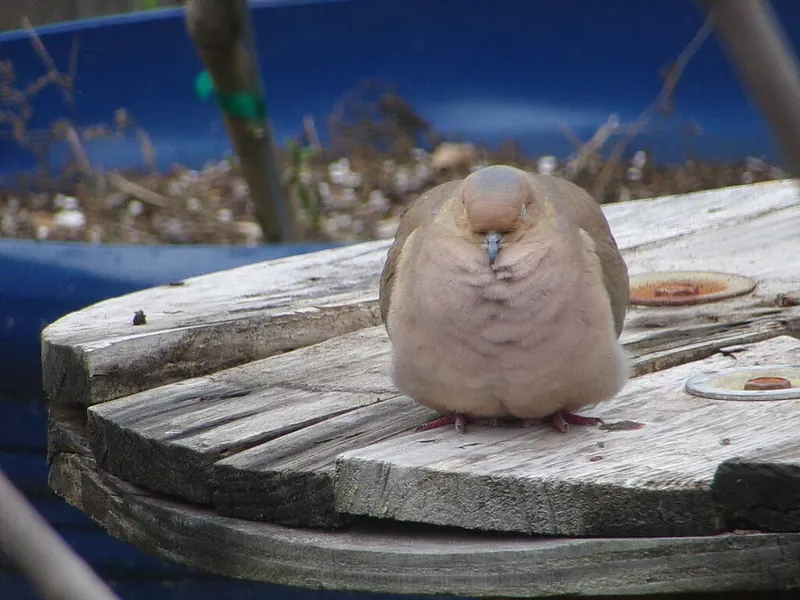
The Mourning Dove is in Ohio all year. It turns up on about 54% of checklists at its peak (mid July) and on 24% in its quietest week (mid November).
When to look
PresentAll year
Peak weekJul 15-21mid July
Quietest weekNov 15-21mid November
Best: mid July. Here all year. Peak: on about 54% of Ohio checklists.
Jancommon
Febcommon
Marpeak season
Aprpeak season
Maypeak season
Junpeak season
Julpeak season
Augpeak season
Seppeak season
Octcommon
Novcommon
Deccommon
Darker months: more checklists report it. Outlined: peak month.
Share of complete checklists reporting it, by week (4 per month). Grey bars: fewer than 10 checklists, not counted.
Frequency is the share of complete checklists in Ohio that listed the bird, 2016–2025. It is not a head count, and it follows where and when people go birding. How to read it.
JanFebMarAprMayJunJulAugSepOctNovDec
today
0%few checklistsno data
Each county is shaded by the share of complete checklists there that listed the bird, blended with the weeks either side. Darker is more often. It follows where people watch birds, not how many birds there are. How to read it.
Darke CountyBest early July · 65 checklists that week, 3,495 in all81%
Logan CountyBest early August · 168 checklists that week, 10,014 in all81%
Gallia CountyBest late August · 13 checklists that week, 1,061 in all80%
Auglaize CountyBest late August · 43 checklists that week, 2,068 in all79%
Hardin CountyBest mid August · 61 checklists that week, 4,583 in all78%
Shelby CountyBest the second week of July · 21 checklists that week, 1,659 in all77%
Best spots
Share of checklists at the peak
Grand River Wildlife AreaTrumbull County, best late June · 33 checklists that week, 1,401 in all100%
Cisler Terrace ParkWashington County, best late March · 21 checklists that week, 704 in all100%
Siebenthaler Wetlands #1Greene County, best early August · 25 checklists that week, 1,103 in all97%
Oakes Quarry ParkGreene County, best late August · 25 checklists that week, 724 in all96%
Mosquito Creek LakeTrumbull County, best late June · 23 checklists that week, 1,490 in all96%
Busy spots report more of everything; compare the checklist counts before you drive anywhere.
Best time of day
In Ohio, the Mourning Dove is most often listed on checklists started between 6 and 8 am (58% of those checklists).
Share of checklists started in each local hour that reported it. It reflects when people go birding as well as when birds are active. Grey hours have too few checklists (under 2% of the state’s, or under 200) to judge.Week-by-week table
Month
Days 1-7
8-14
15-21
22-end
January
23%
26%
27%
27%
February
29%
33%
37%
38%
March
39%
41%
40%
44%
April
45%
45%
46%
47%
May
43%
38%
42%
47%
June
49%
51%
53%
53%
July
54%
54%
55%
55%
August
54%
54%
53%
51%
September
47%
44%
41%
38%
October
35%
31%
28%
26%
November
25%
24%
24%
23%
December
26%
27%
28%
26%
Neighboring states
West Virginia: year-round, peaks the second week of August
The Mourning Dove is in Ohio all year. It turns up on about 54% of checklists at its peak (mid July) and on 24% in its quietest week (mid November).
When do Mourning Doves leave Ohio?
The Mourning Dove does not leave Ohio: it is reported all year, from 24% of checklists in mid November to 54% in mid July.
When is the best time to see a Mourning Dove in Ohio?
The Mourning Dove is reported most often in mid July, on about 54% of Ohio checklists.
Where in Ohio are Mourning Doves seen most often?
By county, Darke County, Logan County, and Gallia County have the highest peak reporting rates for the Mourning Dove (counties with at least 200 checklists).