WhenToBird

Phalaropus lobatus · Scolopacidae

When Do Red-necked Phalaropes Arrive in New Mexico?

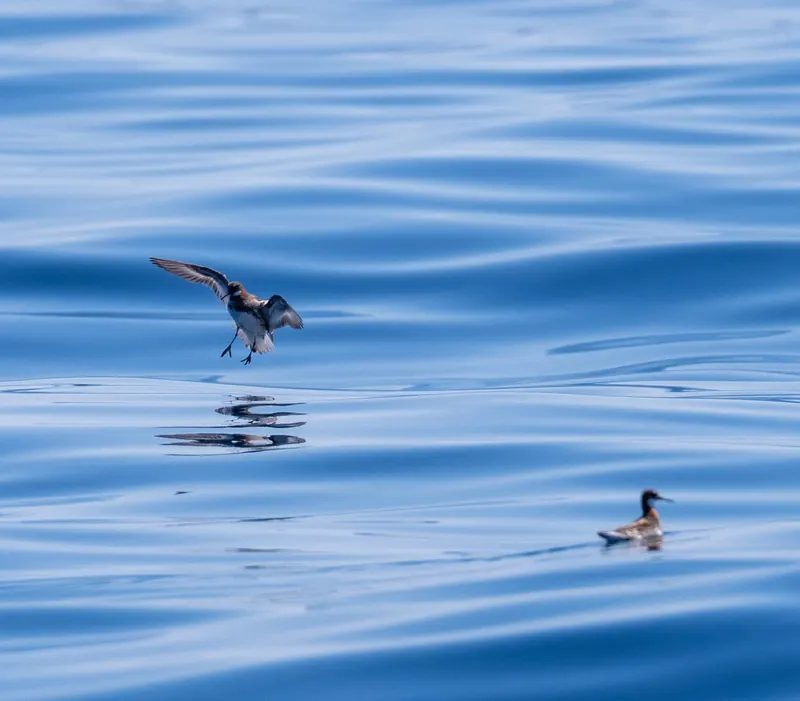
Adult Red-necked Phalarope
Photo: steve b, CC0 1.0 via iNaturalist

Red-necked Phalaropes mostly pass through New Mexico: they arrive in the second week of August, peak in mid September (1.1% of checklists), and most are gone by mid October.

When to look

First arrivalsAug 8-14the second week of August
Common byAug 8-14the second week of August
PeakSep 15-21mid September
Most gone byOct 15-21mid October

Best: mid September. First arrivals the second week of August; most are gone by mid October. Peak: on about 1.1% of New Mexico checklists.

  1. Jannot usually seen
  2. Febnot usually seen
  3. Marnot usually seen
  4. Aprrare
  5. Mayuncommon
  6. Junrare
  7. Julnot usually seen
  8. Auguncommon
  9. Seppeak season
  10. Octcommon
  11. Novnot usually seen
  12. Decnot usually seen

Darker months: more checklists report it. Outlined: peak month.

0%0.5%1%1.5%2%Jan 1-7: 0% of 11827 checklistsJan 8-14: 0% of 9370 checklistsJan 15-21: 0% of 9561 checklistsJan 22-31: 0% of 12707 checklistsFeb 1-7: 0% of 9365 checklistsFeb 8-14: 0% of 10141 checklistsFeb 15-21: 0% of 12431 checklistsFeb 22-28: 0% of 9159 checklistsMar 1-7: 0% of 9348 checklistsMar 8-14: 0% of 9704 checklistsMar 15-21: 0% of 9896 checklistsMar 22-31: 0.1% of 14679 checklistsApr 1-7: 0.1% of 11145 checklistsApr 8-14: 0.1% of 11939 checklistsApr 15-21: 0.1% of 12885 checklistsApr 22-30: 0.1% of 17935 checklistsMay 1-7: 0.2% of 15202 checklistsMay 8-14: 0.3% of 16604 checklistsMay 15-21: 0.5% of 12720 checklistsMay 22-31: 0.3% of 16699 checklistsJun 1-7: 0.1% of 9889 checklistsJun 8-14: 0% of 9322 checklistsJun 15-21: 0% of 8341 checklistsJun 22-30: 0.1% of 10562 checklistsJul 1-7: 0.1% of 9036 checklistsJul 8-14: 0% of 8461 checklistsJul 15-21: 0.1% of 8585 checklistsJul 22-31: 0.1% of 11800 checklistsAug 1-7: 0.1% of 8289 checklistsAug 8-14: 0.1% of 8882 checklistsAug 15-21: 0.2% of 9136 checklistsAug 22-31: 0.2% of 12662 checklistsSep 1-7: 0.4% of 9936 checklistsSep 8-14: 1.7% of 9581 checklistsSep 15-21: 1.0% of 9355 checklistsSep 22-30: 0.6% of 12402 checklistsOct 1-7: 0.7% of 9467 checklistsOct 8-14: 0.3% of 10279 checklistsOct 15-21: 0.1% of 8990 checklistsOct 22-31: 0.1% of 11986 checklistsNov 1-7: 0.1% of 8461 checklistsNov 8-14: 0% of 8801 checklistsNov 15-21: 0% of 8616 checklistsNov 22-30: 0% of 11088 checklistsDec 1-7: 0% of 8444 checklistsDec 8-14: 0% of 8575 checklistsDec 15-21: 0% of 10958 checklistsDec 22-31: 0% of 14523 checklistsJanFebMarAprMayJunJulAugSepOctNovDec
Share of complete checklists reporting it, by week (4 per month). Grey bars: fewer than 10 checklists, not counted.

Frequency is the share of complete checklists in New Mexico that listed the bird, 2016–2025. It is not a head count, and it follows where and when people go birding. How to read it.

JanFebMarAprMayJunJulAugSepOctNovDec
today
Second week of November

Each county is shaded by the share of complete checklists there that listed the bird, blended with the weeks either side. Darker is more often. It follows where people watch birds, not how many birds there are. How to read it.

Embed this map on your site

Where in New Mexico

Best counties

Share of checklists at the peak
  1. Otero CountyBest mid September · 100 checklists that week, 8,483 in all7.5%
  2. Sierra CountyBest mid September · 173 checklists that week, 13,458 in all6.0%
  3. Colfax CountyBest late September · 234 checklists that week, 8,053 in all5.9%
  4. Valencia CountyBest mid September · 150 checklists that week, 8,351 in all5.5%
  5. Curry CountyBest early October · 63 checklists that week, 2,926 in all3.6%
  6. Hidalgo CountyBest late September · 116 checklists that week, 7,579 in all3.6%

Best spots

Share of checklists at the peak
  1. Maxwell National Wildlife RefugeColfax County, best late September · 20 checklists that week, 460 in all28%
  2. Bosque del Apache National Wildlife Refuge (south 2)Socorro County, best mid May · 26 checklists that week, 853 in all21%

Busy spots report more of everything; compare the checklist counts before you drive anywhere.

Best time of day

In New Mexico, the Red-necked Phalarope is most often listed on checklists started between 5 and 7 pm (0.2% of those checklists).

0%0.5%12 am: too few checklists (186) to judge1 am: too few checklists (180) to judge2 am: too few checklists (172) to judge3 am: too few checklists (183) to judge4 am: too few checklists (527) to judge5 am: too few checklists (4013) to judge6 am: 0.1% of 29677 checklists7 am: 0.1% of 71785 checklists8 am: 0.1% of 79208 checklists9 am: 0.1% of 61605 checklists10 am: 0.2% of 49588 checklists11 am: 0.2% of 38079 checklists12 pm: 0.2% of 31089 checklists1 pm: 0.2% of 27524 checklists2 pm: 0.2% of 26644 checklists3 pm: 0.2% of 26849 checklists4 pm: 0.2% of 25156 checklists5 pm: 0.2% of 19061 checklists6 pm: 0.3% of 15112 checklists7 pm: too few checklists (9040) to judge8 pm: too few checklists (2738) to judge9 pm: too few checklists (736) to judge10 pm: too few checklists (384) to judge11 pm: too few checklists (208) to judge12a3a6a9a12p3p6p9p
Share of checklists started in each local hour that reported it. It reflects when people go birding as well as when birds are active. Grey hours have too few checklists (under 2% of the state’s, or under 200) to judge.
Week-by-week table
MonthDays 1-78-1415-2122-end
January0%0%0%0%
February0%0%0%0%
March0%0%0%0.1%
April0.1%0.1%0.1%0.1%
May0.2%0.3%0.5%0.3%
June0.1%0%0%0.1%
July0.1%0%0.1%0.1%
August0.1%0.1%0.2%0.2%
September0.4%1.7%1.0%0.6%
October0.7%0.3%0.1%0.1%
November0.1%0%0%0%
December0%0%0%0%

Neighboring states

  • Arizona: arrives early August, 1 week earlier than New Mexico
  • Colorado: arrives late April, 14 weeks earlier than New Mexico
  • Utah: arrives late April, 14 weeks earlier than New Mexico
  • Wyoming: arrives late April, 14 weeks earlier than New Mexico

Common questions

When do Red-necked Phalaropes arrive in New Mexico?
Red-necked Phalaropes mostly pass through New Mexico: they arrive in the second week of August, peak in mid September (1.1% of checklists), and most are gone by mid October.
When do Red-necked Phalaropes leave New Mexico?
Most Red-necked Phalaropes have left New Mexico by mid October, when reports fall below half their usual rate.
When is the best time to see a Red-necked Phalarope in New Mexico?
The Red-necked Phalarope is reported most often in mid September, on about 1.1% of New Mexico checklists.
Where in New Mexico are Red-necked Phalaropes seen most often?
By county, Otero County, Sierra County, and Colfax County have the highest peak reporting rates for the Red-necked Phalarope (counties with at least 200 checklists).