WhenToBird

Cistothorus stellaris · Troglodytidae

When Do Sedge Wrens Arrive in Wisconsin?

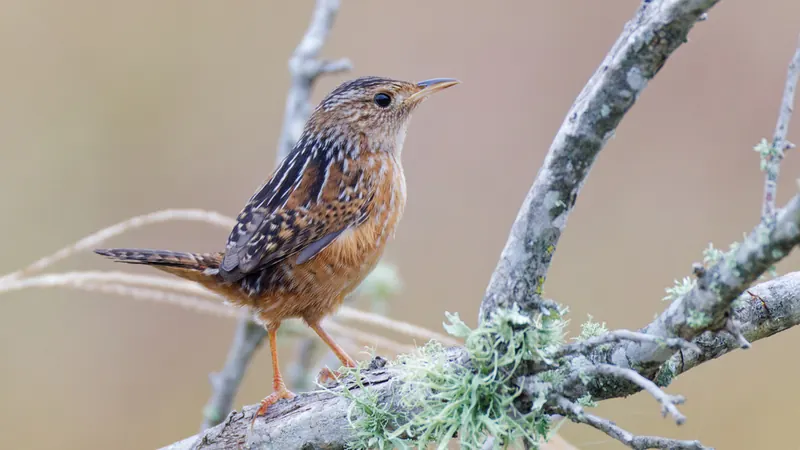
Adult Sedge Wren
Photo: Brent Cox, CC BY 4.0 via iNaturalist

Sedge Wrens reach Wisconsin in early May, are common by the second week of May, peak in mid July (6.7% of checklists), and most are gone by the second week of August.

When to look

First arrivalsMay 1-7early May
Common byMay 8-14the second week of May
PeakJul 15-21mid July
Most gone byAug 8-14the second week of August

Best: mid July. First arrivals early May; most are gone by the second week of August. Peak: on about 6.7% of Wisconsin checklists.

  1. Jannot usually seen
  2. Febnot usually seen
  3. Marnot usually seen
  4. Aprrare
  5. Maycommon
  6. Junpeak season
  7. Julpeak season
  8. Augpeak season
  9. Sepuncommon
  10. Octuncommon
  11. Novnot usually seen
  12. Decnot usually seen

Darker months: more checklists report it. Outlined: peak month.

0%2%4%6%8%Jan 1-7: 0% of 27925 checklistsJan 8-14: 0% of 18337 checklistsJan 15-21: 0% of 17370 checklistsJan 22-31: 0% of 23777 checklistsFeb 1-7: 0% of 16656 checklistsFeb 8-14: 0% of 18286 checklistsFeb 15-21: 0% of 24739 checklistsFeb 22-28: 0% of 20113 checklistsMar 1-7: 0% of 24024 checklistsMar 8-14: 0% of 26722 checklistsMar 15-21: 0% of 27238 checklistsMar 22-31: 0% of 40171 checklistsApr 1-7: 0% of 34961 checklistsApr 8-14: 0.1% of 39128 checklistsApr 15-21: 0.1% of 38887 checklistsApr 22-30: 0.6% of 57231 checklistsMay 1-7: 1.8% of 55115 checklistsMay 8-14: 3.0% of 63098 checklistsMay 15-21: 4.2% of 49821 checklistsMay 22-31: 5.3% of 56796 checklistsJun 1-7: 5.0% of 33621 checklistsJun 8-14: 5.0% of 31282 checklistsJun 15-21: 4.8% of 30186 checklistsJun 22-30: 5.4% of 35128 checklistsJul 1-7: 6.0% of 27088 checklistsJul 8-14: 6.5% of 23293 checklistsJul 15-21: 7.0% of 20933 checklistsJul 22-31: 6.7% of 27595 checklistsAug 1-7: 6.2% of 19147 checklistsAug 8-14: 4.6% of 18286 checklistsAug 15-21: 2.5% of 19195 checklistsAug 22-31: 1.1% of 28229 checklistsSep 1-7: 1.0% of 22408 checklistsSep 8-14: 1.4% of 20857 checklistsSep 15-21: 1.7% of 20707 checklistsSep 22-30: 1.5% of 26469 checklistsOct 1-7: 1.2% of 21069 checklistsOct 8-14: 0.5% of 21011 checklistsOct 15-21: 0.2% of 20006 checklistsOct 22-31: 0.1% of 26362 checklistsNov 1-7: 0.1% of 18928 checklistsNov 8-14: 0% of 17052 checklistsNov 15-21: 0% of 16291 checklistsNov 22-30: 0.1% of 20564 checklistsDec 1-7: 0% of 15354 checklistsDec 8-14: 0% of 16294 checklistsDec 15-21: 0% of 21430 checklistsDec 22-31: 0% of 26314 checklistsJanFebMarAprMayJunJulAugSepOctNovDec
Share of complete checklists reporting it, by week (4 per month). Grey bars: fewer than 10 checklists, not counted.

Frequency is the share of complete checklists in Wisconsin that listed the bird, 2016–2025. It is not a head count, and it follows where and when people go birding. How to read it.

JanFebMarAprMayJunJulAugSepOctNovDec
today
Second week of November

Each county is shaded by the share of complete checklists there that listed the bird, blended with the weeks either side. Darker is more often. It follows where people watch birds, not how many birds there are. How to read it.

Embed this map on your site

Where in Wisconsin

Best counties

Share of checklists at the peak
  1. Pierce CountyBest the second week of August · 114 checklists that week, 7,076 in all29%
  2. Clark CountyBest mid July · 76 checklists that week, 2,369 in all24%
  3. Dunn CountyBest late July · 151 checklists that week, 8,247 in all23%
  4. Rusk CountyBest mid July · 94 checklists that week, 5,768 in all21%
  5. Burnett CountyBest mid July · 201 checklists that week, 11,034 in all19%
  6. Taylor CountyBest early July · 252 checklists that week, 4,326 in all18%

Best spots

Share of checklists at the peak
  1. Powell Marsh Wildlife AreaVilas County, best early July · 28 checklists that week, 480 in all87%
  2. Ozaukee County Waterfowl Production AreaOzaukee County, best late July · 20 checklists that week, 467 in all82%
  3. Pheasant Branch Conservancy Natural Resource AreaDane County, best late July · 34 checklists that week, 949 in all79%
  4. Glacial Habitat Restoration - LmWinnebago County, best mid July · 24 checklists that week, 269 in all77%
  5. Chiwaukee Prairie-Carol Beach Natural Area (State Line)Kenosha County, best late July · 25 checklists that week, 486 in all76%
  6. White River Marsh Wildlife AreaGreen Lake County, best late May · 22 checklists that week, 174 in all75%

Busy spots report more of everything; compare the checklist counts before you drive anywhere.

Best time of day

In Wisconsin, the Sedge Wren is most often listed on checklists started between 5 and 7 am (4.8% of those checklists).

0%2%4%6%8%12 am: too few checklists (993) to judge1 am: too few checklists (844) to judge2 am: too few checklists (839) to judge3 am: too few checklists (1488) to judge4 am: too few checklists (5344) to judge5 am: 6.7% of 27016 checklists6 am: 4.2% of 83973 checklists7 am: 2.3% of 160717 checklists8 am: 1.9% of 160531 checklists9 am: 1.8% of 136968 checklists10 am: 1.6% of 119110 checklists11 am: 1.4% of 99116 checklists12 pm: 1.2% of 85078 checklists1 pm: 1.1% of 80688 checklists2 pm: 1.0% of 79140 checklists3 pm: 1.0% of 78599 checklists4 pm: 1.2% of 69767 checklists5 pm: 1.5% of 53229 checklists6 pm: 2.2% of 38769 checklists7 pm: too few checklists (24396) to judge8 pm: too few checklists (10155) to judge9 pm: too few checklists (4990) to judge10 pm: too few checklists (2463) to judge11 pm: too few checklists (1281) to judge12a3a6a9a12p3p6p9p
Share of checklists started in each local hour that reported it. It reflects when people go birding as well as when birds are active. Grey hours have too few checklists (under 2% of the state’s, or under 200) to judge.
Week-by-week table
MonthDays 1-78-1415-2122-end
January0%0%0%0%
February0%0%0%0%
March0%0%0%0%
April0%0.1%0.1%0.6%
May1.8%3.0%4.2%5.3%
June5.0%5.0%4.8%5.4%
July6.0%6.5%7.0%6.7%
August6.2%4.6%2.5%1.1%
September1.0%1.4%1.7%1.5%
October1.2%0.5%0.2%0.1%
November0.1%0%0%0.1%
December0%0%0%0%

Neighboring states

  • Illinois: arrives early May, in the same week than Wisconsin
  • Iowa: arrives late April, 1 week earlier than Wisconsin
  • Michigan: arrives the second week of May, 1 week later than Wisconsin
  • Minnesota: arrives early May, in the same week than Wisconsin

Common questions

When do Sedge Wrens arrive in Wisconsin?
Sedge Wrens reach Wisconsin in early May, are common by the second week of May, peak in mid July (6.7% of checklists), and most are gone by the second week of August.
When do Sedge Wrens leave Wisconsin?
Most Sedge Wrens have left Wisconsin by the second week of August, when reports fall below half their usual rate. Stragglers are still reported until early October.
When is the best time to see a Sedge Wren in Wisconsin?
The Sedge Wren is reported most often in mid July, on about 6.7% of Wisconsin checklists.
Where in Wisconsin are Sedge Wrens seen most often?
By county, Pierce County, Clark County, and Dunn County have the highest peak reporting rates for the Sedge Wren (counties with at least 200 checklists).