November 8, 2026
Birding in Texas: When to Go, Where to Go and What You'll See (2027 Guide)
Texas birding by the calendar: the April coast fallouts, the Rio Grande Valley, whooping cranes at Aransas and a September hummingbird peak, all from ten years of birder checklists.
The best time to go birding in Texas is the second half of April on the upper coast, when the first big waves of songbirds cross the Gulf of Mexico. The best place depends on what you want: High Island and Galveston for migrants, the Rio Grande Valley for Mexican specialties, Aransas for whooping cranes in winter, and the Hill Country for a bird that nests nowhere else in the world. Texas has good birding in every month, and the data below shows which month fits which goal.
Every percentage in this guide is the share of birder checklists that reported the species, 2016 to 2025, for complete checklists in Texas. It is not a count of birds. It tells you how likely you are to see a species on a typical outing, in the weeks and places where people actually go birding. (If that is new, how to read a bird bar chart explains it.)
What is around, month by month
This table lists the birds that stand out most in each month: species that show up on at least 5% of Texas checklists and at least 1.7 times their yearly average. Year-round birds such as Northern Cardinal and Mockingbird are left out on purpose.
| Month | What stands out (share of checklists) |
|---|---|
| Jan | Yellow-rumped Warbler 39%, Ruby-crowned Kinglet 30%, Orange-crowned Warbler 23%, American Goldfinch 18% |
| Feb | Yellow-rumped Warbler 36%, Orange-crowned Warbler 20%, American Goldfinch 18%, Double-crested Cormorant 16% |
| Mar | Yellow-rumped Warbler 28%, Double-crested Cormorant 16%, Cedar Waxwing 16%, Blue-winged Teal 13% |
| Apr | Barn Swallow 30%, Brown-headed Cowbird 18%, Laughing Gull 18%, Purple Martin 17% |
| May | Barn Swallow 31%, Painted Bunting 23%, Scissor-tailed Flycatcher 18% |
| Jun | Barn Swallow 29%, Painted Bunting 23%, Purple Martin 19%, Scissor-tailed Flycatcher 18% |
| Jul | Barn Swallow 31%, Painted Bunting 20%, Purple Martin 19%, Black-chinned Hummingbird 17% |
| Aug | Ruby-throated Hummingbird 16%, Black-chinned Hummingbird 15%, Mississippi Kite 14%, Green Heron 13% |
| Sep | Ruby-throated Hummingbird 29%, Blue-gray Gnatcatcher 24%, Northern Yellow Warbler 13%, Chimney Swift 12% |
| Oct | American Kestrel 14%, Belted Kingfisher 12%, Northern House Wren 10%, Northern Flicker 10% |
| Nov | Eastern Phoebe 34%, Ruby-crowned Kinglet 30%, Yellow-rumped Warbler 28%, Orange-crowned Warbler 20% |
| Dec | Yellow-rumped Warbler 38%, Ruby-crowned Kinglet 34%, Orange-crowned Warbler 23%, Double-crested Cormorant 17% |
Statewide numbers blur the coast, which is why April looks modest here. Texas is large, and a checklist from Dallas dilutes one from Galveston. The county data further down sharpens the picture.
Spring: late March through May
Spring migration in Texas runs on a ramp. Purple Martins and Barn Swallows reach half of their peak reporting rate by mid-March. Black-chinned Hummingbirds and Scissor-tailed Flycatchers get there in late March. By the second week of April, Summer Tanagers, Indigo Buntings, Gray Catbirds, Orchard Orioles and Red-eyed Vireos have all arrived in force.
Most likely birds in April: Texas
| # | Bird | % of checklists |
|---|---|---|
| 1 | Northern Cardinal | 57% |
| 2 | Northern Mockingbird | 46% |
| 3 | Great-tailed Grackle | 38% |
| 4 | White-winged Dove | 38% |
| 5 | Mourning Dove | 37% |
| 6 | Barn Swallow | 31% |
| 7 | Turkey Vulture | 30% |
| 8 | Carolina Wren | 29% |
| 9 | Red-winged Blackbird | 29% |
| 10 | Blue Jay | 28% |
Based on about 382,073 complete checklists.
The famous event is the fallout. When a cold front meets birds crossing the Gulf, tired migrants drop into the first trees they find. High Island, in Galveston County, is the best-known place for it, with the Houston Audubon sanctuaries at Boy Scout Woods and Smith Oaks. Our data shows how short the window is. In Galveston County, Scarlet Tanagers are on about 21% of checklists at the late-April peak, and they stay above 2% only from the second week of April to the second week of May. Blackburnian Warblers peak in early May at about 10%. Prothonotary Warblers peak in mid April.
Most likely birds in April: Galveston County
| # | Bird | % of checklists |
|---|---|---|
| 1 | Northern Cardinal | 50% |
| 2 | Great-tailed Grackle | 50% |
| 3 | Laughing Gull | 45% |
| 4 | Northern Mockingbird | 41% |
| 5 | Great Egret | 40% |
| 6 | Gray Catbird | 39% |
| 7 | Brown Pelican | 37% |
| 8 | Barn Swallow | 36% |
| 9 | Red-winged Blackbird | 34% |
| 10 | Snowy Egret | 33% |
Based on about 48,484 complete checklists.
If you can pick only one stretch, take the last two weeks of April and the first week of May. You will not see a fallout every day, because fallouts need weather, but the odds of colorful migrants are highest then.
Inland, the Hill Country has the Golden-cheeked Warbler, which nests only in Texas. In Travis County it reaches half its peak around mid-March and peaks in early April at about 9% of checklists. Balcones Canyonlands National Wildlife Refuge near Austin is the usual place to look.
Summer: Painted Buntings and the quiet heat
June and July are the thin months on the coast but fine inland. Painted Buntings are the stars: they reach about 24% of checklists statewide in early June, and half of that rate or more from late April through early August. Scissor-tailed Flycatchers peak in late May at about 18%, and Purple Martins reach their statewide high in late June near 21%.
Painted Bunting in Texas
For the cooler, higher country, Big Bend National Park is the place for the Colima Warbler, which is found in the Chisos Mountains. In Brewster County it appears on checklists from mid-April, peaks in mid-May at about 6%, and is gone by the second week of August.
Fall: the hummingbird surprise
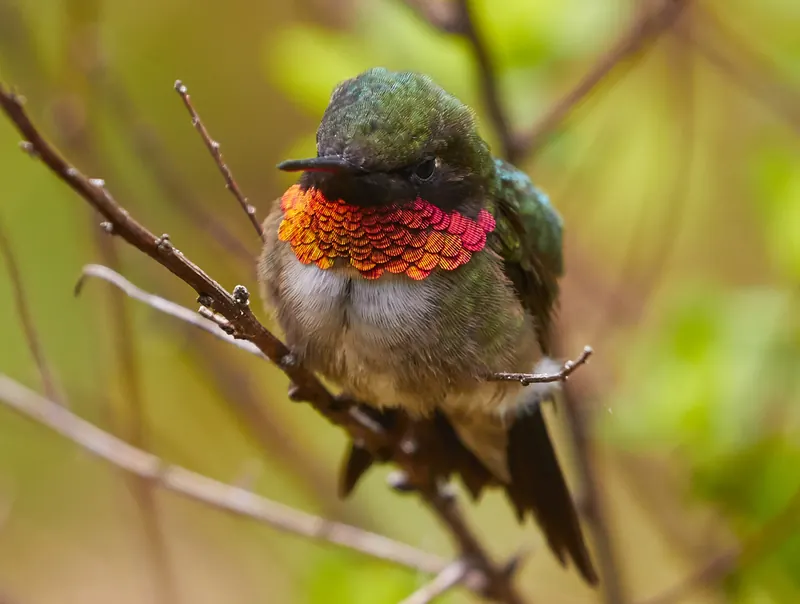
Most people think of hummingbirds as a spring story. In Texas, the data says September. The Ruby-throated Hummingbird peaks statewide in mid-September at about 30% of checklists, higher than any spring week, and stays above half that rate from mid-August to the second week of October. In Galveston County the peak is about 33%.
Ruby-throated Hummingbird in Texas
If you want to see the most hummingbirds, go in September, when adults and young birds crowd feeders on their way to the Gulf. Rockport holds a hummingbird festival around then each year for that reason. If you only feed them in spring, you are catching the small first wave. Our hummingbird feeder timing for Texas lays out when to put feeders up and when to leave them out.
Black-chinned Hummingbirds, the common nester in the western two-thirds of the state, peak earlier: about 17% in the second week of July.
Winter: cranes, spoonbills and the Valley
Winter is the best time to see whooping cranes. At Aransas, in Aransas County, they appear on a large share of local checklists. Their reporting rate averages about 28% across the winter months and peaks near 32% in early December. Aransas National Wildlife Refuge and the boat tours out of Rockport are the usual approach. The cranes in our data are reported from the county, not only the refuge, so the numbers also include birders on the coast road.
Whooping Crane in Aransas County
South of there, the Rio Grande Valley is a winter destination for people who want Mexican birds. Hidalgo County has Green Jay on about 55% of winter checklists, and Altamira Oriole on about 25%. Santa Ana National Wildlife Refuge, Estero Llano Grande State Park and Bentsen-Rio Grande Valley State Park are the usual stops. Cameron and Hidalgo counties together rank in the top five Texas counties by checklists, so the Valley is among the best-covered regions in the state.
Across Texas in January, the common winter birds are Yellow-rumped Warblers (39% of checklists), Ruby-crowned Kinglets (30%) and Orange-crowned Warblers (23%). In Hidalgo County, Orange-crowned Warbler rises to more than 55%.
Timing cheat sheet
Here are the first and last weeks when each of these Texas birds is on at least 2% of checklists, and the week of its peak. Use them to pick a week, and give yourself a few days either side, because weather moves every year.
- Ruby-throated Hummingbird: on at least 2% of checklists from mid Mar to 2nd wk Nov; peak in mid-Sep at about 30%.
- Black-chinned Hummingbird: on at least 2% of checklists from 2nd wk Mar to early Oct; peak in the second week of Jul at about 17%.
- Painted Bunting: on at least 2% of checklists from 2nd wk Apr to mid Sep; peak in early Jun at about 24%.
- Scissor-tailed Flycatcher: on at least 2% of checklists from mid Mar to 2nd wk Nov; peak in late May at about 18%.
- Purple Martin: on at least 2% of checklists from mid Feb to mid Sep; peak in late Jun at about 21%.
Where the birders are
The counties with the most complete checklists are Harris (205,000), Travis (170,000), Galveston (130,000), Hidalgo (119,000) and Cameron (118,000). That mix is a hint about where Texans and visitors go: Houston, Austin, the upper coast and the Valley. These are the places where our data is strongest. Western counties have far fewer checklists, so treat their numbers as rougher.
Plan your trip
- Spring migrants on the coast: go from about April 15 to May 5. See birds in Texas in April and May.
- Hummingbirds: go in September. See Texas hummingbird feeder timing.
- Whooping cranes and wintering waterbirds: go from December to February. See birds in Texas in January.
- Where to go: the Texas birding spots list ranks locations by how many birders report from them.
- One species at a time: check Painted Bunting in Texas, Whooping Crane in Texas or Golden-cheeked Warbler in Texas.
For a wider view of the calendar, see when spring migration starts across the country.
Related
- Ruby-throated Hummingbird: when and where, by state
- Painted Bunting: when and where, by state
- Whooping Crane: when and where, by state
- Scissor-tailed Flycatcher: when and where, by state
- Golden-cheeked Warbler: when and where, by state
- Birds in Texas, month by month
- Best birding spots in Texas
Tags: texas, state guide, birding in texas, spring migration, hummingbirds