November 8, 2026
What Birds Stay for the Winter? Residents, Visitors and the Ones That Swap Places
Cardinals and chickadees stay, juncos and tree sparrows arrive, and robins swap places. Here is how to tell which winter birds are which in your state.
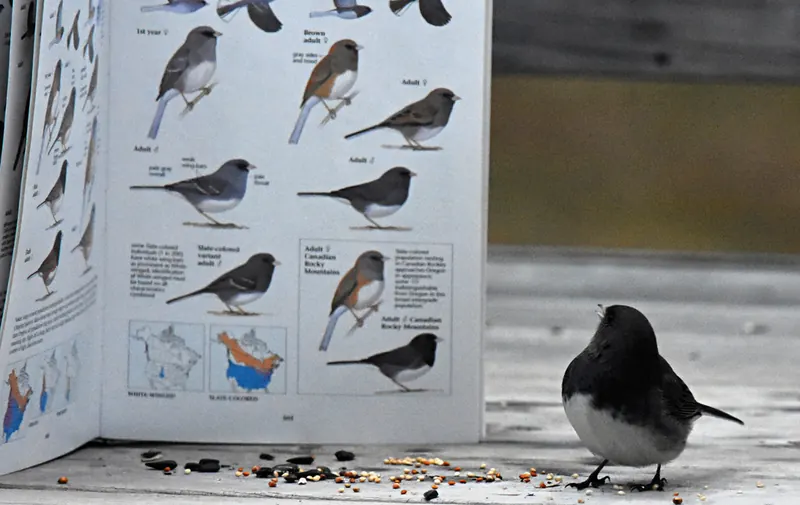
In most of the northern states, the birds that stay all winter are the ones you already know from your feeder: Northern Cardinal, Black-capped Chickadee, Tufted Titmouse, Blue Jay, the woodpeckers, nuthatches and House Finch. Joining them are birds that spend the summer farther north and come south for winter, mainly Dark-eyed Juncos and American Tree Sparrows.
The more useful answer is that "stays for the winter" covers three different things, and sorting your birds into them explains a lot about what you see at the feeder.
Group one: true residents
These birds are on the same patch of land in July and January. A cardinal that sings in your yard in June is very likely the same cardinal at your feeder in February. Chickadees, titmice, nuthatches, downy and hairy woodpeckers, Carolina Wrens and Blue Jays are the usual cast, though Blue Jays are more complicated than they look (some jays migrate in loose flocks, especially in fall along lake shores).
On a bar chart, a resident is a flat line. The bars barely change from January to July.
Northern Cardinal in Ohio
Residents do change their behavior. In summer they defend territories and eat insects. In winter they form flocks, roam widely and lean on seeds, suet and berries, which is why they show up at feeders in numbers when the leaves are down and the ground is frozen.
Group two: winter visitors
These birds nest farther north and spend the winter in your area. For the northern half of the country, the headliners are Dark-eyed Junco and American Tree Sparrow. Both breed in Canada and the far north. Juncos arrive in October and are gone by April in most of the Midwest and Northeast; tree sparrows come a little later and leave a little earlier.
On a bar chart, a winter visitor is a hump that sits in the cold months and nearly vanishes in summer.
Dark-eyed Junco in Ohio
American Tree Sparrow in Michigan
You may also see juncos in your yard in summer if you live in the mountains or in northern New England and the Great Lakes, because some breed there. In Ohio and Pennsylvania, the juncos at your feeder in January are mostly from farther north.
Group three: the swap
This is the group that fools people. The species is present all year, but the individual birds change. American Robins are the classic case. Robins nesting in your yard in June may head south in fall, while robins that nested in Canada move in and spend the winter nearby. You may feel like the robins leave, then wonder why you see flocks of them in January.
What changes is behavior. In winter, robins stop eating worms and lawn insects and switch to fruit. They move into wooded areas, crabapples, hollies, junipers and other berry-heavy places, and they stay out of sight at feeders because most do not eat seed. That is why "where do the robins go" is a real question even though some are still around.
American Robin in Pennsylvania
Look at how the bars change through the year, and compare the winter weeks with late winter, when robins start moving back toward lawns and singing.
What the most common January birds look like in your state
Here is how the picture changes by state. This list shows the species reported on the largest share of birder checklists in January.
Most likely birds in January: Ohio
| # | Bird | % of checklists |
|---|---|---|
| 1 | Northern Cardinal | 49% |
| 2 | Blue Jay | 42% |
| 3 | Downy Woodpecker | 40% |
| 4 | Red-bellied Woodpecker | 36% |
| 5 | Canada Goose | 35% |
| 6 | White-breasted Nuthatch | 34% |
| 7 | Dark-eyed Junco | 33% |
| 8 | Tufted Titmouse | 30% |
| 9 | Mallard | 30% |
| 10 | American Crow | 29% |
Based on about 138,113 complete checklists.
Most likely birds in January: Michigan
| # | Bird | % of checklists |
|---|---|---|
| 1 | Black-capped Chickadee | 51% |
| 2 | Downy Woodpecker | 41% |
| 3 | Northern Cardinal | 41% |
| 4 | Blue Jay | 40% |
| 5 | Dark-eyed Junco | 39% |
| 6 | White-breasted Nuthatch | 38% |
| 7 | American Crow | 34% |
| 8 | American Goldfinch | 32% |
| 9 | Mourning Dove | 32% |
| 10 | Red-bellied Woodpecker | 31% |
Based on about 110,490 complete checklists.
Most likely birds in January: Wisconsin
| # | Bird | % of checklists |
|---|---|---|
| 1 | Black-capped Chickadee | 54% |
| 2 | Dark-eyed Junco | 43% |
| 3 | Downy Woodpecker | 42% |
| 4 | American Crow | 41% |
| 5 | White-breasted Nuthatch | 38% |
| 6 | Northern Cardinal | 36% |
| 7 | American Goldfinch | 32% |
| 8 | Mourning Dove | 30% |
| 9 | Blue Jay | 30% |
| 10 | Red-bellied Woodpecker | 30% |
Based on about 88,392 complete checklists.
Compare the lists with the list for July in your own state, linked below. The feeder regulars appear in both. The changes (juncos and tree sparrows in January, warblers, swallows and hummingbirds in July) are your visitors and your migrants.
Why some birds can stay
Wintering is a food problem, not a cold problem. A chickadee can survive a night of minus 20 if it finds enough calories during the day; birds fluff feathers, shiver and slow their metabolism. What a bird cannot do is survive if the insects are gone and it eats only insects. That's why flycatchers, swallows, warblers and hummingbirds leave, while seed eaters, fruit eaters and bark foragers can stay.
You can add to that food supply. Black oil sunflower seed is the best single food for the widest range of winter birds. Suet helps woodpeckers, nuthatches and chickadees, and a source of open water helps all of them. If you want juncos and tree sparrows, scatter seed on the ground under a feeder or near brush, since they feed on the ground.
Where to look next
Every state has its own cast, and the details change a lot as you move south or west. For a species-by-species list for your state, see the winter birds in Ohio, Michigan and Pennsylvania pages, or pick your own from the state list. If you want to know when the winter visitors will leave, open the Dark-eyed Junco page and look for the week the bars drop off.
If your feeder is quieter than you expected, read this before you blame the birds.
Related
- Dark-eyed Junco: when and where, by state
- Northern Cardinal: when and where, by state
- American Robin: when and where, by state
- American Tree Sparrow: when and where, by state
- Birds in Ohio, month by month
- Best birding spots in Ohio
- Birds in Michigan, month by month
- Best birding spots in Michigan
- Birds in Pennsylvania, month by month
- Best birding spots in Pennsylvania
- Birds in Wisconsin, month by month
- Best birding spots in Wisconsin
Tags: winter, resident birds, feeders